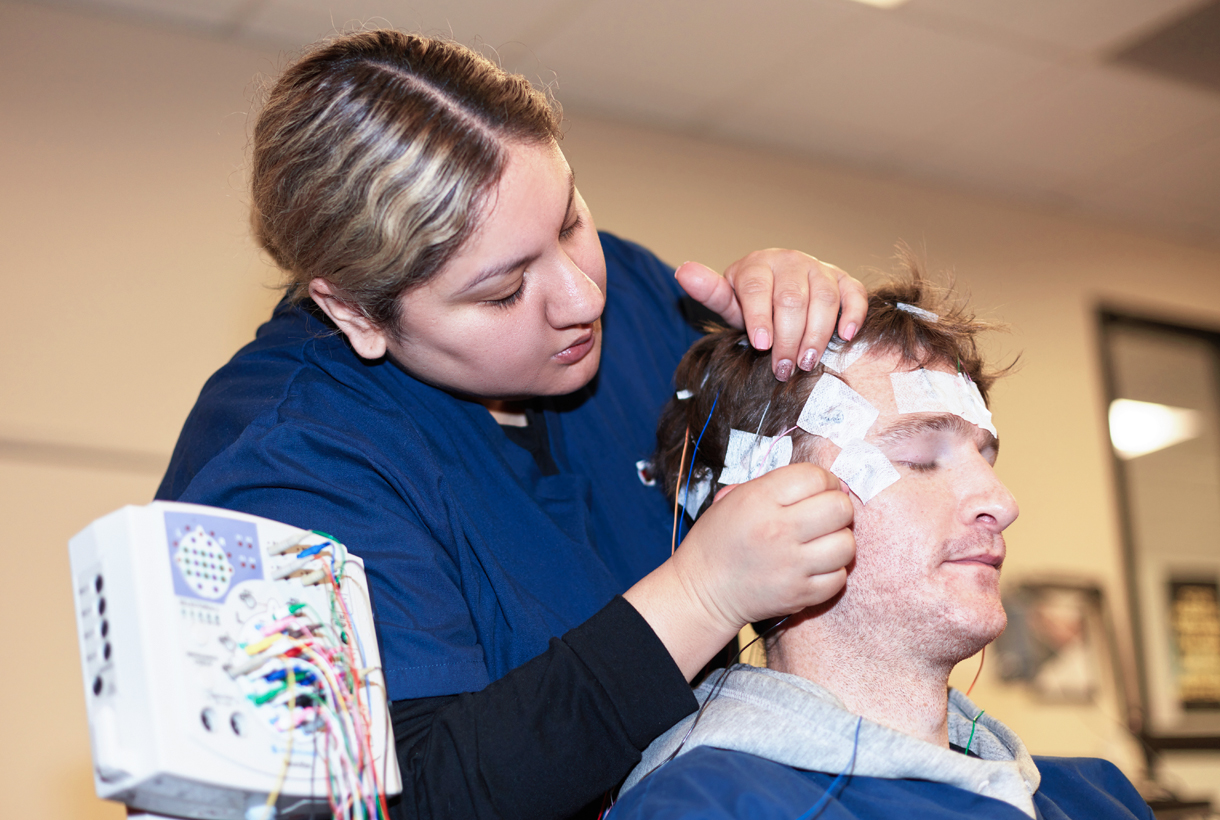
MCC student securing electrodes on a test subject for long-term EEG recording and epilepsy monitoring in the lab.
Midwestern Career College is currently accepting applications for the Electroneurodiagnostic (END) Technology program.
Fall 2026 enrollment is open. Call (312) 236-9000 ext. 1 to book your enrollment appointment.
Midwestern Career College’s Electroneurodiagnostic (END) Technologist hybrid program immerses students in the study of electrical brain activity and gives them the practical skills needed to set up, record, and interpret EEG tests in healthcare settings. After three semesters, including a full semester of clinical rotation, graduates are well-prepared to begin a fulfilling career as EEG Techs.
Curious about becoming an EEG Tech?
Individuals interested in becoming an EEG tech often have a strong interest in neuroscience, medical technology, and patient care. They may also be fascinated by brain function and the electrical activity within it. Interest in the diagnostic process, the impact of neurological disorders, and the role of technology in healthcare are often part of what draws students to this field.
Some of our students also come from personal or family connections to epilepsy, which drives their desire to make a meaningful difference in patients’ lives and actively contribute to improved care and outcomes.
Identify goals, personal strengths and important facts about your potential career path so you can make an informed decision about your future. It takes just a few minutes!
“MCC’s students are driven, highly motivated, and eager to learn. They stand out from other colleges and programs. We look forward to continuing building our partnership with MCC and supporting students’ success.”
— Prachi A., Director, MG Operations Neurosciences at Endeavor Health
What Do EEG Techs Do?
Electroneurodiagnostic technologists record electrical activity of the brain, spinal cord, and peripheral nerves. They prepare patients for procedures, obtain medical histories, and work with specially trained physicians who interpret testing data and provide clinical impressions. END professionals may specialize in one or more neurodiagnostic procedures, creating opportunities to work in areas such as neurology and surgery.
EEG Electrode Placement: The 10–20 System in Practice
EEG acquisition begins with precise anatomical measurement. Technologists use the 10–20 system to map electrode placement based on landmarks, symmetry, and proportional spacing—small variations that directly influence signal quality and clinical interpretation. This foundational skill is introduced early in the Electroneurodiagnostic (END) Technologist program.
Program Objectives
Demonstrate the knowledge and principles needed to work as a competent Electroneurodiagnostic / Electroencephalograph (END) technologist in a variety of healthcare facilities.
Develop critical thinking and problem-solving skills to analyze data during recordings and help ensure the information obtained is valid and interpretable.
Demonstrate professionalism and ethical behavior.
Develop effective communication skills within the healthcare environment.
Promote professional growth in the field through continued lifelong learning.
This program includes 550 hours of clinical externship at an MCC-affiliated site. The externship provides real-life field and patient-care experience, helping students transition from the academic environment into professional practice.
MCC partners with the Epilepsy Foundation of Greater Chicago, a nonprofit serving 44 counties across Illinois. EFGC provides education, advocacy, and case management for individuals living with epilepsy, their families, and their communities. MCC also participates in each year’s Fall 5K. Come and run with us! Learn more about EFGC.
As an EEG Technologist, you will be entering a growing neurodiagnostic healthcare field that also offers opportunities for advancement into related specialties. O*NET also describes the skills, interests, and work activities associated with this career path.
With additional education and training, END professionals may expand into areas such as:
Frequently Asked Questions About MCC’s EEG Tech Program
What is an EEG Tech?
An EEG Tech, also called an Electroneurodiagnostic (END) Technologist, works with patients and specialized equipment to record electrical activity in the brain and nervous system. EEG Techs help support testing used in the diagnosis and monitoring of neurological conditions.
How long is the Electroneurodiagnostic (END) Technology program at MCC?
MCC’s Electroneurodiagnostic (END) Technology program is designed to be completed in three semesters, including a full semester of clinical rotation.
Is MCC’s END program offered online or on campus?
MCC’s END program is offered in a hybrid format. Students complete coursework through a combination of instruction and hands-on training, including in-person clinical experience.
Does the program include clinical training?
Yes. The program includes 550 hours of clinical externship at an MCC-affiliated site, giving students real-life field and patient-care experience.
Success Story: “I would say my biggest takeaway was the need for people in this field”
Does MCC’s END program support R. EEG T. certification preparation?
Yes. MCC’s program is approved by the American Board of Registered Electroneurodiagnostic Technologists (ABRET) as a pathway to R. EEG T. certification.
Explore More in Electroneurodiagnostic (END) Technology
Inside MCC: Student Life, Skills, and Career Stories
Midwestern Career College shares student stories, program highlights, campus updates, career content, and college news across our official social media channels. Explore our latest content and follow MCC on the platforms you use most.
Official MCC channels: Facebook, Instagram, YouTube, and LinkedIn.