Program Objectives
- Provide the knowledge and skills required for students to succeed in an entry-level cardiovascular sonographer position.
- Provide sufficient didactic and hands-on lab education regarding Non-Invasive Cardiovascular Sonographer tasks in a cardiac lab, medical center, technology center, or hospital.
- Discuss clinical activities in which the student will apply critical thinking skills.
- Provide understanding of patient care procedures in the cardiac field.
- Provide hands-on training to perform diagnostic tests like EKG/ECG and stress EKG.
- Provide understanding of performing Holter monitoring.
- Prepare students to take and pass the Certified Cardiographic Technician (CCT) examination.
- Prepare students to perform effectively as skilled allied health professionals with skills needed to meet the demand for quality employees.
Curriculum
This program consists of two modules
Certified Cardiology Technician (CCT):
A comprehensive curriculum that prepares students for entry-level positions in the cardiac technology field in a medical center or a hospital cardiology department. Classroom instruction covers patient care, cardiac anatomy, physiology and pathology, EKG/ECG, Holter monitoring, and stress testing.
Noninvasive Cardiovascular (Echo) Sonographer:
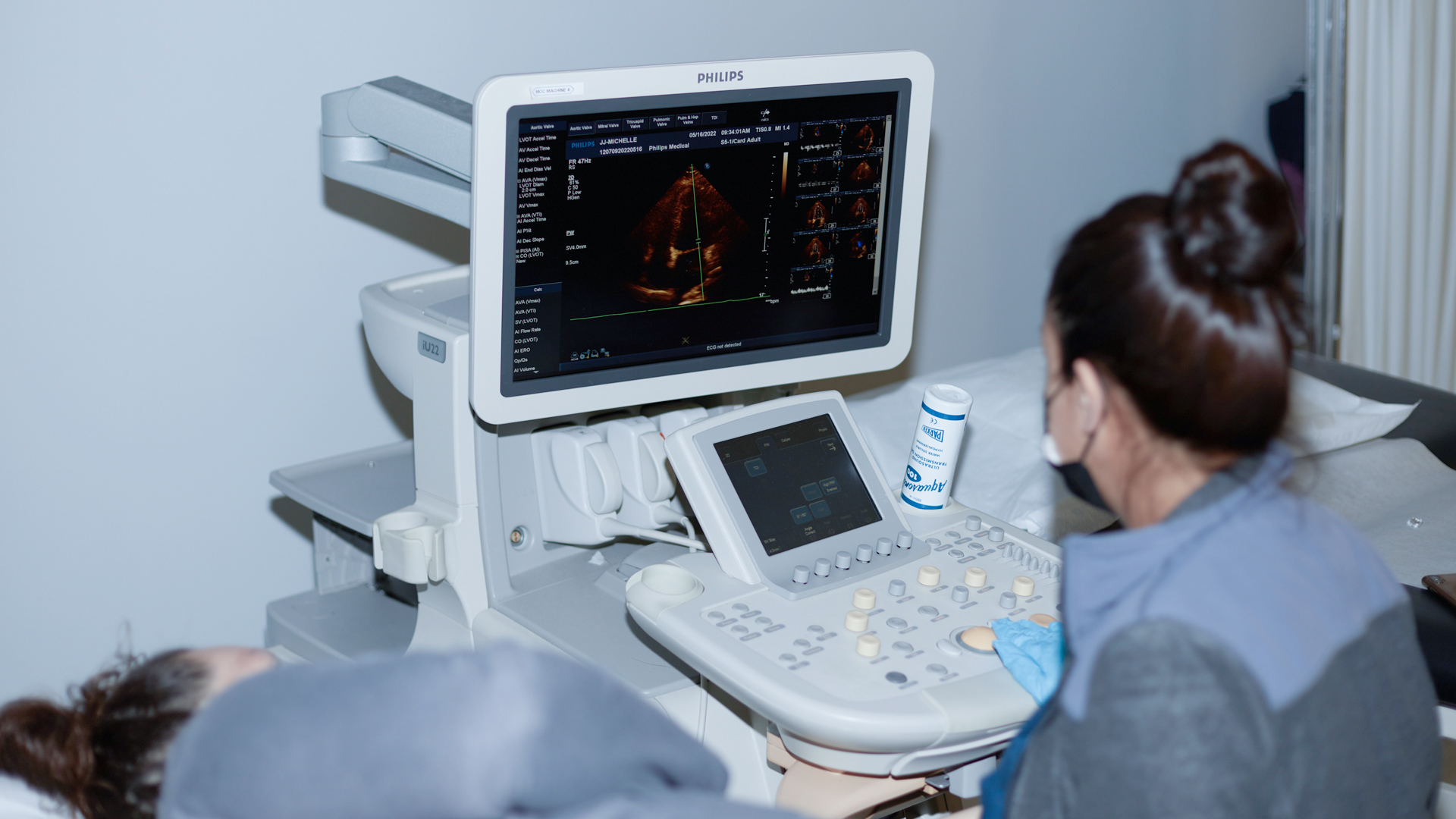
Covers the noninvasive diagnosis and treatment of patients with cardiac (heart) and peripheral vascular (blood vessels) disease. It is a multidisciplinary science requiring the technologist to be trained and educated to utilize ultrasound equipment to recognize, calculate, interpret, and analyze data derived from the cardiac study.
The Associate of Applied Science in Noninvasive Cardiovascular Sonography program curriculum follows the recommendations of the American Society of Radiologic Technologists (ASRT) Cardiac-Interventional and Vascular-Interventional Curriculum Guide and the joint committee of the Association of Educators in Imaging and Radiological Sciences (AEIRS).
It addresses the topics listed in the Cardiovascular Credentialing International
outline and follows the rules and regulations of the American College of Radiology (ACR).
Externship
Students must complete a 450-hour externship.
Certifications
This program provides eligibility to become Certified Cardiographic Technician (CCT) through Cardiovascular Credentialing International (CCI).
This program provides pathway to Registered Cardiac Sonographer (RCS) certification exam eligibility through Cardiovascular Credentialing International (CCI) with the completion of additional 350 clinical hours not provided by MCC.
This program provides eligibility for the Sonography Principles & Instrumentation (SPI) Examination through the American Registry for Diagnostic Medical Sonography (ARDMS).
A graduate of MCC’s Associate of Applied Science in Non-Invasive Cardiovascular Sonography program may qualify to sit for Registered Diagnostic Cardiac Sonographer (RDCS) certification through ARDMS if prior to admission into this program he or she has graduated from:
- a two-year allied health educational program that is patient care related (prerequisite 1). Allied health occupations include, but are not limited to, diagnostic medical sonographer, radiologic technologist, respiratory therapist, physical therapist, and registered nurse;
- or with a bachelor’s degree in any major (prerequisite 3A);
- or after working for one year in the Ultrasound field from the date of graduation from MCC’s AAS in Diagnostic Medical Sonography program (prerequisite 1);
- or after earning Registered Cardiac Sonographer (RCS) certification through Cardiovascular Credentialing International (CCI) (prerequisite 5).
Per ARDMS General Prerequisites guide, “prerequisite requirements are subject to change at any time and from time to time. Applicants must meet current prerequisite requirements at the time of application.” For detailed prerequisite information students should refer to ARDMS.org.
Career Outlook
According to the U.S. Bureau of Labor Statistics (BLS), employment for cardiovascular sonographers is projected to grow by 4% from 2025 to 2035, which is considered as fast as average.
Projected Job Growth for Non-Invasive Cardiovascular Sonographers (2025–2035)
Cardiovascular Sonography
4%
Source: BLS.gov – U.S. Department of Labor data, 2025–2035.
More on cardiovascular sonography