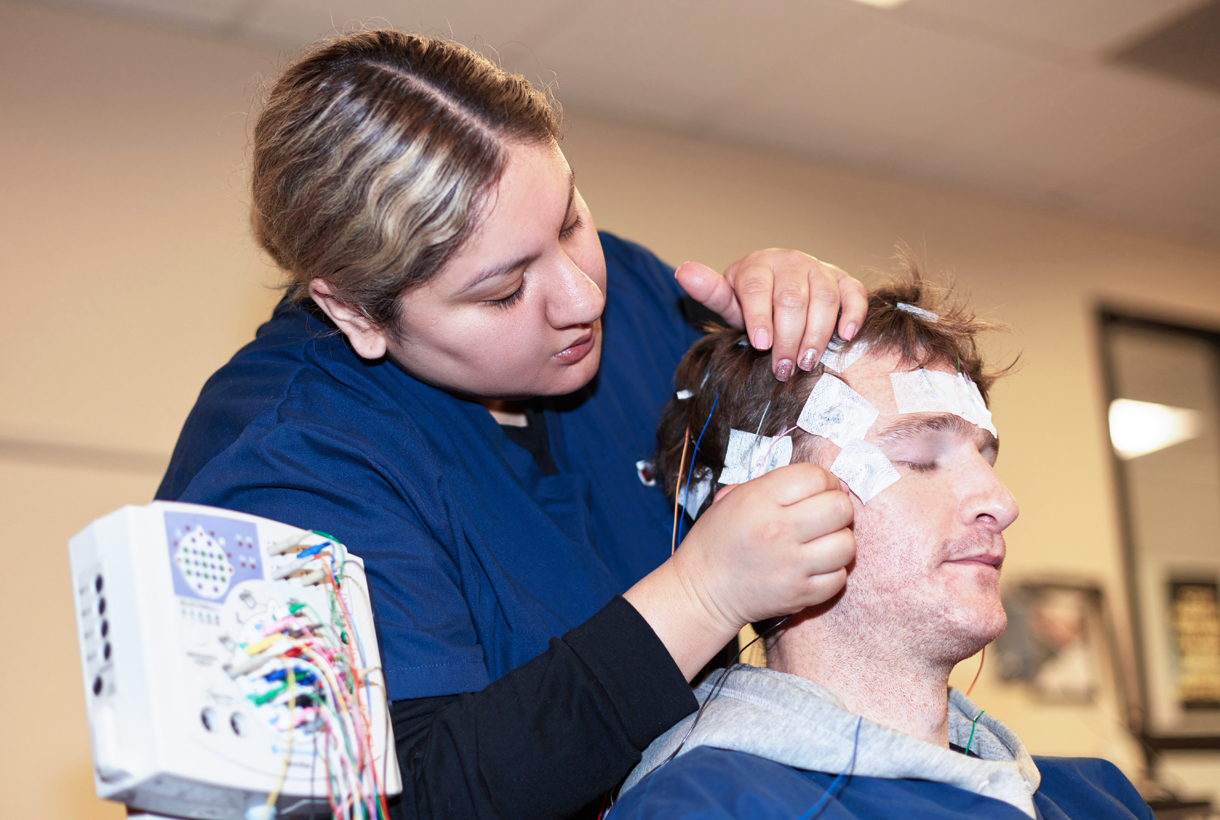
MCC student securing electrodes on a test subject for long-term EEG recording and epilepsy monitoring in the lab.
Midwestern Career College is currently accepting applications for the Electroneurodiagnostic (END) Technology program.
Fall 2026 enrollment is open.Call (312) 236-9000 ext. 1 to book your enrollment appointment.
What Does MCC’s Electroneurodiagnostic Technology Program Include?
Midwestern Career College’s Electroneurodiagnostic (END) Technology program prepares students for entry-level work as electroencephalographic (EEG) technologists. The hybrid program combines instruction in brain activity, nervous system function, EEG recording procedures, and patient care with practical training in applying electrodes, operating diagnostic equipment, and recognizing EEG recording patterns.
How Long Is MCC’s Electroneurodiagnostic Technology Program?
MCC’s Electroneurodiagnostic Technology program consists of three semesters, including a full semester of supervised clinical rotation. Students combine classroom and laboratory learning with clinical experience in healthcare environments where EEG testing and neurological monitoring are performed.
What Does an EEG Technologist Do?
EEG technologists use specialized equipment to record electrical activity in the brain. They prepare patients for examinations, apply electrodes, monitor recording quality, and document relevant observations for physician review. EEG testing can help healthcare professionals evaluate neurological conditions, including epilepsy and other disorders affecting brain function.
Curious About Becoming an EEG Tech?
Individuals interested in becoming an EEG technologist often have a strong interest in neuroscience, medical technology, and patient care. They may be fascinated by brain function, electrical activity, and the role of diagnostic technology in understanding neurological conditions.
Some students also have personal or family connections to epilepsy, inspiring an interest in supporting patients and contributing to neurological care.
JO
Jennifer O’Brien, EEG T, CLTM
Registered Neurodiagnostic Technologist | Northwestern Memorial Hospital
Employer Perspective
“My experience with the Midwestern Career College students has been extremely positive. Not only do the students show up on time and are ready to learn, but they also ask intelligent questions. They consistently show us that they are excited to be a part of our team. I would highly recommend the Neurodiagnostic program to any potential students. The program has allotted classroom time, and also a certain number of hours to be completed at local hospitals for hands-on training. We have hired numerous students after they have completed their training. Thank you Midwestern Career College for sending us wonderful, well-rounded employees.”
Identify goals, personal strengths and important facts about your potential career path so you can make an informed decision about your future. It takes just a few minutes!
“MCC’s students are driven, highly motivated, and eager to learn. They stand out from other colleges and programs. We look forward to continuing building our partnership with MCC and supporting students’ success.”
— Prachi A., Director, MG Operations Neurosciences at Endeavor Health
EEG Electrode Placement: The 10–20 System in Practice
EEG acquisition begins with precise anatomical measurement. Technologists use the 10–20 system to map electrode placement based on anatomical landmarks, symmetry, and proportional spacing. Accurate placement supports consistent signal quality and reliable EEG recordings. This foundational skill is introduced early in MCC’s Electroneurodiagnostic Technology program.
Program Objectives
Demonstrate the knowledge and principles needed to work as a competent Electroneurodiagnostic / Electroencephalograph (END) technologist in a variety of healthcare facilities.
Develop critical thinking and problem-solving skills to analyze data during recordings and help ensure the information obtained is valid and interpretable.
Demonstrate professionalism and ethical behavior.
Develop effective communication skills within the healthcare environment.
Promote professional growth in the field through continued lifelong learning.
The program includes 550 hours of clinical externship at an MCC-affiliated site. The externship provides practical experience in a clinical environment, allowing students to apply their classroom and laboratory training while working with patients and healthcare professionals.
Certifications
MCC’s Electroneurodiagnostic Technology program is approved by the American Board of Registered Electroneurodiagnostic Technologists (ABRET) as a pathway toward the Registered EEG Technologist (R. EEG T.) credential. Graduates must meet ABRET’s applicable examination and eligibility requirements to earn professional registration.
MCC Partnership: Epilepsy Foundation of Greater Chicago
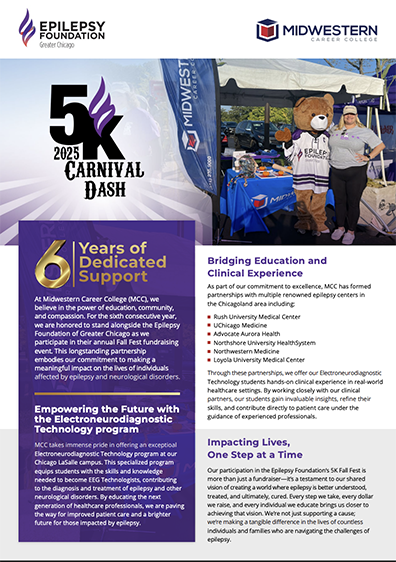
MCC partners with the Epilepsy Foundation of Greater Chicago, a nonprofit serving 44 counties across Illinois. EFGC provides education, advocacy, and case management for individuals living with epilepsy, their families, and their communities. MCC also participates in the organization’s annual Fall 5K event. Learn more about the Epilepsy Foundation of Greater Chicago.
Career Outlook
According to O*NET Online, employment in the broader occupational category used for Neurodiagnostic Technologists is projected to grow by 6% from 2025 to 2035, faster than the average of approximately 3% across all occupations. This projection reflects the broader Health Technologists and Technicians, All Other category rather than EEG technologists exclusively.
With additional education, experience, and specialized training, END professionals may pursue work in related areas, including:
Source: O*NET Online – National Employment Trends, using U.S. Department of Labor projections for 2025–2035. Neurodiagnostic Technologists are represented by the broader occupational category.
Inside MCC: Student Life, Skills, and Career Stories
Midwestern Career College shares student stories, program highlights, campus updates, career content, and college news across our official social media channels. Explore our latest content and follow MCC on the platforms you use most.
Official MCC channels: Facebook, Instagram, YouTube, and LinkedIn.